

The Community Climate Resilience Plan has been adopted
Thank you to everyone who helped develop the Community Climate Resilience Plan
Council adopted the final proposed document which no amendments at their meeting on Monday 5 October 2026. To view the meeting minutes or watch the recording, go to Council's website.
Community feedback and next steps
Thank you to everyone who provided feedback on the draft Community Climate Resilience Plan during public exhibition from 15 July to 12 August 2026.
Community feedback helped refine the final Plan before it is presented to Council for consideration on 5 October 2026.
Key themes included support for stronger community preparedness, protecting trees and green spaces, supporting vulnerable community members, improving communication about cool spaces and emergency preparedness, and clarifying parts of the draft Plan.
Across all stages of the project:
- 329 community members participated through in-person or online workshops or pop-ups, emailed us directly, or engaged through our Advisory Committees
- 221 surveys were completed
- 2,129 people visited the Shaping Banyule project page
The stage 3 engagement findings report is now available to download.
Community members shared a range of views, experiences and suggestions. Key themes included:
- More support to help people prepare for extreme weather events such as heatwaves, storms, flooding and power outages.
- Greater support for residents who may find it harder to adapt to climate change, including renters, low-income households and other vulnerable community members.
- Strong protection and enhancement of trees, shade and green spaces across Banyule.
- More education, communication and practical information to help people understand climate risks and available support.
- Clearer explanations of actions, priorities, timeframes, budgets and how decisions were made.
Based on community feedback, we:
- Improved clarity and readability throughout the Plan.
- Made actions, priorities and implementation approaches easier to understand.
- Improved explanations about climate risks and how priorities were identified.
- Considered feedback relating to community vulnerability, preparedness and resilience when finalising the Plan.
- Improved explanations of how decisions were made and why actions were prioritised.
Not every suggestion resulted in a change to the Plan.
Some suggestions did not result in changes because the Plan builds on climate risk assessments, expert advice, Council staff workshops and community feedback gathered across three stages of engagement over two years.
This includes:
- The Plan's overall focus on reducing emissions and preparing for climate-related risks such as heatwaves, flooding, storms, drought, bushfires and power outages.
- The climate risks identified as priorities for Banyule.
- Actions that were developed through earlier stages of engagement, staff workshops and advisory committee input.
Some feedback related to matters that are already addressed through other Council strategies, plans or programs. Other feedback raised broader issues that sit outside the scope of this Plan. While these suggestions did not result in changes to the Plan, they will help inform future work across Council where relevant.
An officer report is scheduled to be presented to Council at its meeting on Monday 5 October 2026.
The report will seek Council adoption of the Community Climate Resilience Plan.
Listen to Lisa Conley, Banyule's Community Climate Action Lead, speak about the Community Climate Resilience Plan.
Background
Over the past two years, we have developed Banyule's first Climate Adaptation Plan. We have combined it with our existing Community Climate Action Plan to create one plan to help reduce carbon emissions.
The new Community Climate Resilience Plan brings together our efforts to reduce carbon emissions (climate mitigation) and prepare for and respond to the impacts of climate change (climate adaptation). It sets out actions Council will take to lower emissions and respond to risks such as extreme storms, heatwaves, flooding and bushfires.
What we've done
To develop the draft Community Climate Resilience Plan, we:
- Assessed Banyule's climate-related risks. View the technical document.
- Asked the community for feedback over six weeks to help shape the Plan. View the Stage 2 findings report.
- Worked with Council staff through monthly co-design workshops to develop and improve the Plan.
- Worked with the Banyule Environment and Climate Action Advisory Committee, made up of residents, to identify the most important climate risks and decide which ones to respond to first.
- Developed an in-depth methodology for community transparency and to guide other local governments in creating adaptation plans. View the methodology document.
Thank you for sharing your feedback on the draft Plan. Feedback is now closed.
Our climate action journey
Declaring a climate emergency
In 2019, Council declared a climate emergency, joining over 100 councils across Australia and representing around 11.4 million people. Since then, Council has worked to reduce greenhouse gas emissions from its own operations. This work is guided by the Corporate Emissions Reduction Plan (CERP), which was updated in 2025 and focuses on actions like electrifying Council buildings and vehicles.
Community climate action
Council has also supported climate action in the community through the Community Climate Action Plan (CAP), first endorsed in 2020. This plan focused on helping people learn more about climate change and take action at home, such as improving energy efficiency and using renewable energy.
The original CAP mainly focused on reducing emissions. While it included some actions to adapt to climate change, it did not go far enough in explaining how Council and the community can prepare and respond to climate impacts. In 2025, we reviewed the plan and asked the community and staff if it was still working well. Most people supported the current actions but said there should be more focus on climate adaptation.
What's changing
To reflect this feedback, we have updated the plan and renamed it the Community Climate Resilience Plan, which will be endorsed by Council in October 2026.
The new plan shares what we’ve achieved since 2020 and takes a closer look at community and staff feedback. It places a stronger focus on helping Banyule prepare for and adapt to a changing climate.
Stage 2 engagement
Community engagement
From 18 September - 26 October 2025, 185 people provided feedback on climate adaptation and extreme weather impacts through an online survey, story portal, interactive map, pop-up sessions and targeted sessions with at-risk networks.
Take a look below at some of the other things we heard, or do a deeper dive by reading the Feedback Summary Report.
What we heard
Stage 2 interactive map
We asked you to tell us where you think there are climate-related risks or opportunities in Banyule (e.g., are you concerned about extreme heat in your neighbourhood or flooding issues?). We received over 20 comments!
Your feedback will help shape the draft Community Climate Action and Adaptation Plan which is now available for comunity feedback.
Take a look at the interactive map below and view the comments made.
Stage 1 engagement
Community engagement
From 15 January to 24 March 2024, we asked the community to help us shape a sustainable and resilient community.
We heard feedback through a variety of engagement activities including:
- 145 people provided feedback through an online survey
- community forums (54 participants)
- presentations with Banyule Advisory and Population Committees
- in-person engagement at Eco Festival (100+ participants)
View the full findings report take a look at a summary of what we heard below.
What you told us
What you told us about Climate Adaptation.
- Over 80% of respondents are extremely concerned or very concerned about the possible impacts of climate change.
- Almost 60% of respondents stated that their level of preparedness for the impacts of climate change is 'fair to good' and that they'd like to see Council do more work in this space.
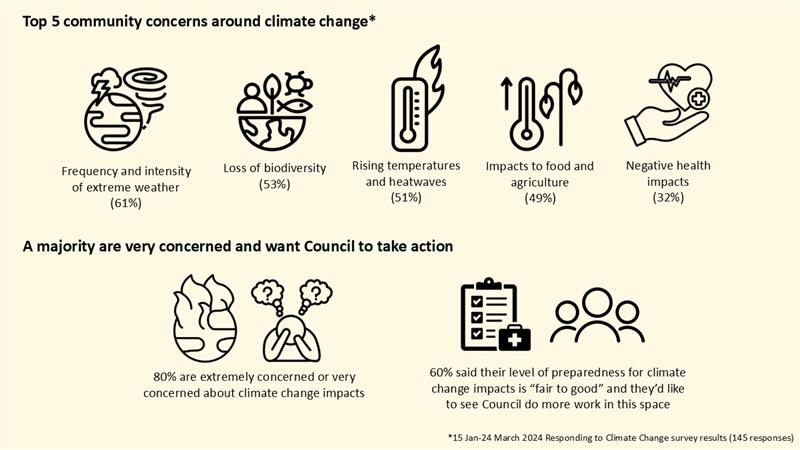
Preliminary community and staff engagement conducted in early 2024 emphasised the community's concern for climate change impacts and the need for proactive adaptation measures. Suggested focus areas included infrastructure resilience, biodiversity preservation and sustainable transport initiatives. The feedback reflected the desire for effective climate action and community involvement in resilience building efforts.
Click the '+Follow' button to stay up-to-date with this project.